Building Information Modelling (BIM) is no longer a nice to have. For those operating in the UK construction and property sectors, it has become a core part of how projects are designed, delivered, and managed.
But if you’re at the start of your BIM journey, or trying to improve what you already do, it can feel like a lot to take in. That’s where we come in.
At AdaptiveBIM, we help organisations adopt and grow BIM in a way that’s practical, proportionate, and genuinely useful. In this blog, we’ll walk through what a typical BIM journey looks like, why it matters, and how we support you at every stage.
First things first, who are AdaptiveBIM?
We are a UK‑based BIM consultancy working across the full building lifecycle. From BIM‑compliant measured surveys to project coordination, COBie‑ready handovers, and ongoing asset support, we help clients meet modern BIM requirements without unnecessary complexity.
Our team brings together real‑world construction experience and deep technical BIM expertise.
So why adopt BIM?
Simply put, BIM adds value for every part of the built environment from subcontractors to designers to building owners. Let’s break down the benefits of BIM:
For smaller contractors looking to grow, BIM provides:
For architects and engineers:
For owners and FM teams:
What happens if I don’t have BIM?
If BIM isn’t in place, organisations are increasingly limited in what they can do. Without BIM you can’t bid for UK public projects over £2 million, many Tier 1 contractors won’t consider you, projects are more fragmented and less coordinated with information frequently being lost between design, construction and handover.
What BIM makes possible
With BIM embedded into your workflows, you can build reusable resources such as templates, and families. Each project becomes faster, more predictable, and more cost‑effective, coordination improves and risk drops.
BIM Level 2 changes how projects run by shifting coordination to earlier stages. By sharing 3D models, we reduce misunderstandings, teams collaborate more effectively, clashes are identified early and pricing and programming become more reliable.
These gains help reduce operating costs, boost sustainability performance, and significantly cut the risk of disputes (one of the most expensive problems in construction).
When asset requirements are defined from the start, the handover process becomes a lot simpler. Building management systems can be populated automatically significantly reducing the time spent on manual data entry. Information arrives in the correct format, there’s no need to convert files and key asset details like warranties. Installation dates and locations are instantly accessible. Good BIM pays for itself many times over at handover.
Your BIM Implementation Roadmap
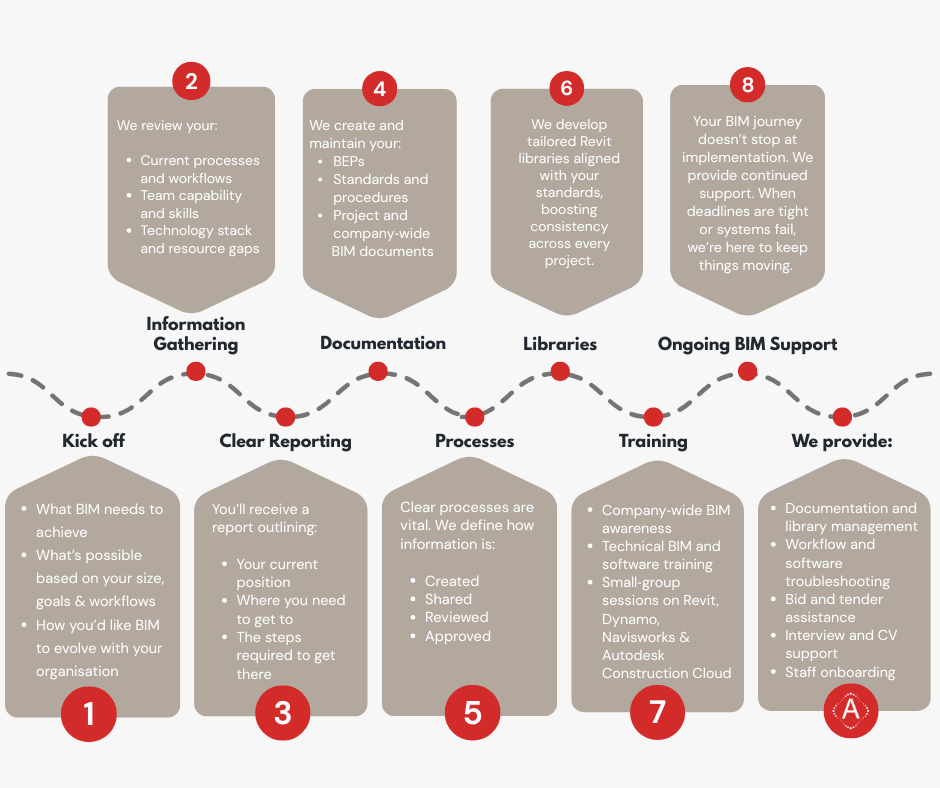
BIM is a living asset
Your building may stay the same but your BIM shouldn’t. We keep your Revit models up to date, cloud-hosted and ready for future design teams. This ensures your BIM remains a useful working resource and not an outdated archive.
Ready to Start Your BIM Journey?
Whether you’re brand‑new to BIM or looking to develop what you already have, AdaptiveBIM can guide you every step of the way.
Give us a ring on 01224 460362 or drop a line at hello@adaptivebim.com